
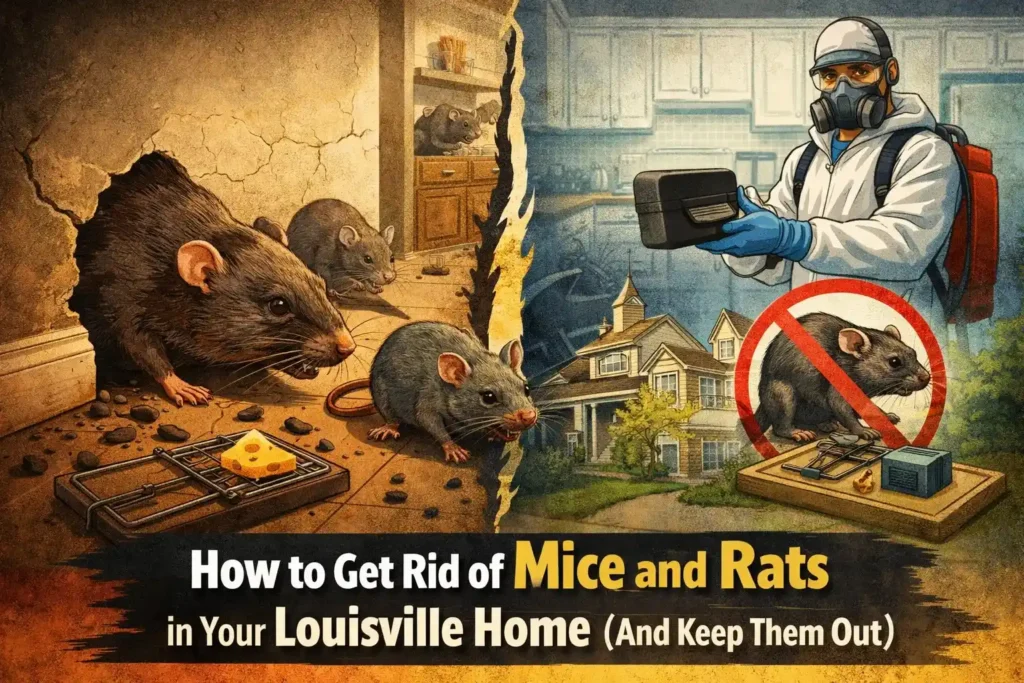
Mice and rats don’t need much of an invitation. A gap the width of a dime is enough for a mouse to squeeze through. Once inside a Louisville home, they move fast, nesting behind walls, chewing through wiring, contaminating food, and breeding before most homeowners even realize the problem exists. Effective Rodent Control Louisville is crucial to prevent damage and health risks, as traps alone often fail to stop these persistent pests.
If you’ve heard scratching in the walls at night or spotted droppings near your kitchen cabinets, you’re not dealing with a lone rodent. You’re dealing with the visible edge of a much larger problem.
This guide covers what to look for, why standard traps consistently fall short, and what professional rodent control in Louisville actually involves.
Signs You Have a Rodent Problem in Your Home
Rodents are nocturnal and cautious by nature, which means a daytime sighting almost always signals a serious infestation. The population has grown large enough that competition for food and space is pushing them into the open.
Watch for these signs before things get to that point:
Droppings are the most reliable indicator. Mouse droppings are small, dark, and pointed at both ends, roughly the size of a grain of rice. Rat droppings are larger, about the size of a raisin. Finding them near food storage, under sinks, or along baseboards confirms active activity.
Gnaw marks on food packaging, wood trim, drywall, or electrical wiring are a serious red flag. Rats in particular chew constantly to wear down their teeth, and chewed wiring is one of the leading causes of house fires attributed to rodent activity.
Grease marks along walls are left by rats, whose coats pick up oils from surfaces they run along repeatedly. You’ll often see these smear marks along baseboards and behind appliances.
Nesting materials, shredded insulation, fabric, paper, or cardboard tucked into quiet corners, confirm that rodents have moved past the exploration stage. They’re settled in.
If you’re unsure whether what you’re seeing points to rodents or another pest, our guide on hidden pest signs in your Louisville home walks through how to read the evidence room by room.
Why Louisville Homes Are Particularly Vulnerable
Louisville’s mix of older housing stock, humid summers, and cold winters creates ideal conditions for rodent pressure year-round. Mice and rats actively move indoors as temperatures drop in October and November, seeking warmth, water, and food. Homes near Beargrass Creek, the Ohio River floodplain, or densely wooded neighborhoods in the east end see higher rodent activity than the regional average.
Older homes, particularly those built before 1980, often have foundation gaps, deteriorated weatherstripping, and utility penetrations that were never properly sealed. These are the entry points that make rodent control in Louisville a recurring problem rather than a one-time fix.
Why Traps Alone Don’t Solve a Rodent Infestation
Hardware store snap traps and glue boards catch individual rodents. That’s genuinely all they do. A female mouse produces 5 to 10 litters per year with 6 to 8 pups per litter. If you’re trapping one or two mice a week, the colony is almost certainly growing faster than you’re removing from it.
The deeper problem is entry. No amount of trapping stops new rodents from coming in through the same gaps that let the first ones inside. Without identifying and sealing those entry points, you’re managing symptoms indefinitely rather than resolving the infestation.
This is exactly why most DIY rodent control attempts cycle the same way: some initial success, a quiet period, then the scratching starts again. If you’ve been through that cycle more than once, it’s worth reading through our breakdown of why pest problems keep coming back; the same principles that apply to insects apply directly to rodents.
What Professional Rodent Control in Louisville Actually Involves
Professional mouse and rat removal is a three-stage process, and all three stages matter.
Stage 1, Inspection. A licensed technician walks the full perimeter of the property, identifies active entry points, checks crawl spaces and attic access, and assesses the severity of the infestation. This step determines everything that follows; it’s not a formality.
Stage 2, Treatment. Depending on the infestation, this may include interior bait stations, snap trap placement in targeted areas, tamper-resistant exterior bait stations, and, in some cases, rodenticide application in void spaces. The treatment plan is built around what the inspection found, not a generic package.
Stage 3, Exclusion. This is what separates a professional rodent control service from a DIY attempt. Exclusion means physically sealing every entry point found during the inspection, gaps around pipes, cracks in the foundation, compromised vents, and gaps under doors. Without exclusion, the property remains open to re-entry indefinitely.
Most professional rodent control plans include at least one follow-up visit to confirm trap activity has stopped and re-inspect any areas of concern. Understanding what to look for in a pest control provider before you book is worth the time. Our guide on choosing the right exterminator in Louisville covers exactly what questions to ask.
Rodent Prevention: What Homeowners Can Do Right Now
Between professional treatments, these steps reduce the risk of re-infestation significantly:
- Seal gaps around any pipe penetrations entering the home with steel wool and caulk; rodents can’t chew through steel wool
- Fix damaged weatherstripping on exterior doors; a gap at the bottom is a direct entry point
- Store pantry food in hard-sided containers; cardboard boxes and thin plastic bags are not barriers for mice
- Keep firewood stacked at least 20 feet from the home’s exterior; stacked wood is prime nesting habitat
- Clear dense ground cover and leaf piles away from the foundation, especially before autumn
These steps won’t eliminate an active infestation, but they make your home significantly less attractive to rodents looking to move in as temperatures drop.
Frequently Asked Questions
1. How do I know if I have mice or rats in my Louisville home?
Mice leave small, rice-sized droppings and chew small, clean holes. Rats leave larger droppings, greasy wall marks, and gnaw much bigger openings. Both require professional treatment.
2. Can rodents cause structural damage to my home?
Yes. Rats and mice chew wiring, insulation, and wood framing. Chewed electrical wiring is a documented fire hazard and can cause significant structural repair costs if left untreated.
3. Are over-the-counter rodent traps effective?
They catch individual rodents but don’t stop re-entry or address the colony. Without sealing entry points, new rodents continue entering regardless of how many traps you set.
4. How quickly can a rodent infestation grow?
A single female mouse can produce up to 60 offspring per year. A small infestation left untreated for two months can become a serious colony problem requiring extensive professional intervention.
5. Is professional rodent control safe for pets and children?
Licensed exterminators in Louisville use tamper-resistant bait stations and regulated products applied at safe concentrations. Your technician will advise on any specific precautions needed after treatment.
6. How much does rodent control cost in Louisville KY?
A single professional rodent treatment typically ranges from $150 to $400, depending on the property size and severity. Ongoing quarterly protection plans generally run $40 to $80 per month.
Hearing scratching at night or finding droppings in your kitchen? Don’t wait for the population to grow. Contact Pest Control Louisville for a same-day inspection and a treatment plan that actually addresses the source.